Quick Summary: Wondering how to install a downspout correctly the first time? This complete guide walks you through everything – from choosing the right materials and tools, to a full step-by-step downspout installation process, to maintenance, repair, and cost breakdowns. Whether you’re a DIY homeowner or ready to hire a licensed contractor in the Bronx, NY, Best Construction Choice Inc has you covered.
What Is a Downspout and Why Does It Matter?
A downspout is a vertical pipe that channels rainwater from your roof’s gutters down to the ground or into a drainage system, directing it safely away from your home’s foundation. In other words, it is the final and most critical part of your home’s entire roof water runoff system.
Without properly installed downspouts, water pooling around your foundation can cause serious long-term damage, including:
- Foundation cracks and structural damage (repairs cost $2,300–$6,800)
- Basement flooding (waterproofing runs $4,500–$15,500)
- Soil erosion around your landscaping
- Mold and mildew growth inside walls and crawl spaces
As a result, downspouts are not optional extras they are essential components of any home’s exterior waterproofing strategy. Furthermore, they represent one of the most cost-effective investments you can make in your home’s long-term protection.
Types of Downspouts and Their Benefits
Not all downspouts are created equal. Therefore, choosing the right material matters greatly for your home, local climate, and budget.
| Material | Cost (Installed) | Lifespan | Best For |
|---|---|---|---|
| Vinyl | $5–$8/linear ft | 10–20 years | Budget-conscious installs |
| Aluminum | $5–$8/linear ft | 20–30 years | Most residential homes |
| Steel (Galvanized) | $9–$12/linear ft | 20–30 years | Heavy snow/harsh weather |
| Copper | $17–$20/linear ft | 50+ years | Historic/premium homes |
Aluminum downspouts are the most popular choice for residential homes. Because of their lightweight design and natural resistance to rust, they are ideal for the Bronx, NY’s variable weather conditions.
Common downspout sizes to consider:
- 2″×3″ rectangular — best for smaller gutter systems or low-rainfall areas
- 3″×4″ rectangular — better suited for homes with larger gutters; recommended for most NY homes
- Round downspouts — commonly used with half-round gutters; sizing varies by region
How Downspouts Work with Your Gutter System
Before you learn how to install a downspout, it helps to understand how the entire gutter drainage system works together. Here’s the complete flow from roof to ground:
- Gutters collect rainwater along the roofline
- Gutter slope directs water toward the downspout — the gutter should slope 1/4 inch for every 10 feet so that water moves efficiently without pooling
- Downspout outlet (also called a drop outlet) creates the opening where water enters the downspout
- Downspout elbows redirect water from horizontal to vertical flow
- Downspout straps/brackets anchor the pipe firmly to your exterior wall
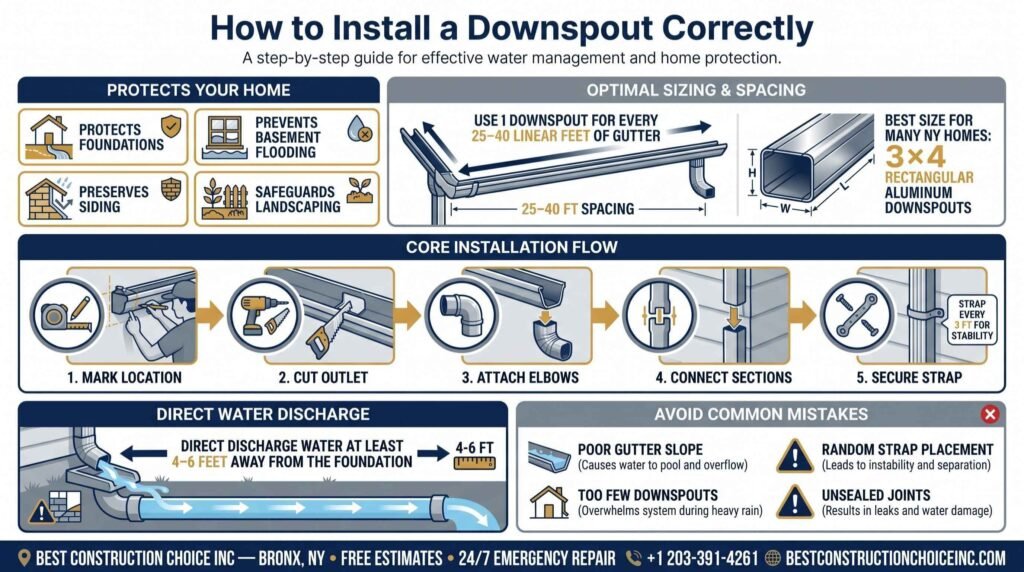
- Extensions or splash blocks direct water at least 4–6 feet away from your foundation
Together, this system protects your roof, walls, foundation, and landscaping from costly water damage all year round.
How Many Downspouts Does a House Need?
This is one of the most common questions homeowners ask before they install a downspout. Here’s the short answer:
As a general rule, install one downspout for every 25–40 linear feet of gutter.
Moreover, here is a practical breakdown by home size:
| Home Size | Typical Downspouts Needed |
|---|---|
| Small (under 1,200 sq ft) | 2 downspouts |
| Medium (1,200–2,400 sq ft) | 3–4 downspouts |
| Large (2,400–3,600 sq ft) | 4–5 downspouts |
| Very large (3,600+ sq ft) | 5–6+ downspouts |
Key factors that affect this number:
- Roof pitch — steeper roofs move water faster and consequently require more downspouts
- Rainfall intensity — the Bronx, NY averages over 46 inches of rain per year, so adequate drainage is critical
- Gutter size — 5-inch K-style gutters handle different volumes than 6-inch gutters
- Roof valleys — where two roof sections meet, water concentrates; therefore, place a downspout within 10 feet of any valley
Pro Tip from Best Construction Choice Inc: Always place downspouts at the corners of your home and at the lowest points of each gutter run, where gravity naturally pulls water.
Tools You Need to Install a Downspout
Before you begin to install a downspout, it’s important to gather everything you need first. Having all tools and materials ready in advance will make the entire process smoother and significantly more efficient.
Tools:
- Tape measure
- Step drill bit and power drill
- Tin snips (metal-cutting snips)
- Hand seamer
- Ladder
- Level
- Marker or chalk line
- Safety glasses and gloves
Materials:
- Downspout sections (typically sold in 10-foot lengths)
- Downspout outlet/drop outlet
- Downspout elbows (A-style for forward-facing, B-style for side-facing)
- Downspout straps/brackets
- Self-tapping screws or pop rivets
- Waterproof silicone sealant
- Splash block or downspout extension
How to Install a Downspout: Step-by-Step Guide
Now that you have your tools and materials ready, here is exactly how to install a downspout on a gutter from start to finish. Follow each step carefully to ensure a leak-free, long-lasting installation.
Step 1: Plan and Mark Your Downspout Location
First, decide where your downspout will run. It should sit at the lowest point of the gutter run, well away from doors, windows, and your home’s foundation. Additionally, make sure it will discharge water where it won’t flood a walkway or your neighbor’s yard. Once you’ve decided on the location, mark the wall from the gutter all the way down to the ground with a chalk line.
Step 2: Install the Downspout Outlet on the Gutter
Next, hold the downspout outlet (also called a drop outlet) against the bottom of the gutter at your chosen location. Use a marker to trace the inside of the outlet opening onto the gutter.
- Use a power drill to create a starter hole inside the traced outline
- Then, using tin snips, cut carefully along the traced line
- Apply silicone sealant one inch from the edge of the downspout outlet’s outside perimeter
- Finally, secure the outlet with two pop rivets on each side
Step 3: Attach the Upper Elbow
After securing the outlet, measure the distance from the edge of the fascia to the side of the house — generally around two feet, though it doesn’t need to be exact. Then, attach the upper elbow to the downspout outlet by nesting it securely into place.
- Attach two rivets to each side, making sure they penetrate both the straight downspout and the elbow
- When installing, ensure the seam either faces toward the sky or presses firmly against the wall
Step 4: Measure and Cut Downspout Sections to Length
Subsequently, measure from the upper elbow down to the ground, accounting for any intermediate elbows. Cut sections using tin snips as needed. In addition, prepare the end of each section by notch-cutting all four corners by 1¼ inches so that sections nest together properly without gaps.
Step 5: Attach Downspout Sections from Top to Bottom
Working your way from top to bottom, attach each section using self-tapping screws to secure it to the wall brackets.
- The lower sections should be attached with two pop rivets on three sides
- The final section typically comes with a 45-degree downspout kickout already factory-attached
Step 6: Install Downspout Straps Every Three Feet
Once all sections are in place, secure downspout straps every three feet along the wall. Place each strap over seams between elbows and straight sections, as these are the weak points in the system.
💡 Important: For two- and three-story homes, add a strap every two feet instead — because the higher your downspout runs, the greater the wind force it must withstand during NY storms.
Step 7: Attach the Lower Elbow and Extension
Finally, attach elbows at the bottom of the downspout to direct water away from your foundation. The downspout extension or splash block should move water at least 4–6 feet from the foundation — and even farther if you have a finished basement below grade.
How to Connect Downspout Elbows When You Install a Downspout
Elbows are the curved fittings that redirect water flow around corners. There are two types that are essential to know:
- A-elbows (front-facing): redirect flow forward and away from the wall
- B-elbows (side-facing): redirect flow to the side along the wall
To connect elbows correctly, follow these steps:
- Nest the elbow snugly over the end of the downspout section
- Ensure a tight, secure fit before fastening anything
- Attach with two rivets on each side for a strong hold
- Seal the joint with waterproof silicone sealant to prevent future leaks
- Additionally, check the alignment periodically to ensure they continue directing water away from the house
How to Secure Downspouts to Siding
A properly anchored downspout won’t rattle, sag, or pull away from the wall during storms. Here is how to do it correctly:
- First, mark every three feet down the downspout length using a tape measure
- Then place straps directly over seams between elbows and straight sections
- Use screws appropriate for your siding type — wood screws for wood siding, vinyl-safe fasteners, or masonry anchors for brick
- For aluminum siding, always use stainless steel or aluminum screws to prevent rust staining on the exterior
- Tighten firmly enough to hold, but also allow for slight seasonal expansion and contraction as temperatures change
Don’t place straps randomly — doing so weakens the overall drainage system and creates movement where it absolutely shouldn’t happen.
How to Extend a Gutter Downspout
If your downspout doesn’t discharge far enough from your foundation, you will need an extension. Fortunately, several options are available:
Above-Ground Extensions:
- Simple rigid extensions: cost $5–$20 and extend 2–4.5 feet
- Flexible/roll-out extensions: contract when dry, then extend automatically when water flows through
- Hinged extensions: flip out of the way conveniently for lawn mowing and maintenance
Underground Drainage Systems: For maximum protection, consider burying your downspout drainage underground. These systems cost $150–$350 per downspout and can route water 100+ feet from your foundation. As a result, they are especially valuable for Bronx, NY homes with finished basements or poor yard grading.
To connect a basic above-ground extension:
- Disconnect the existing elbow at the bottom of the downspout
- Attach the extension using a connector fitting
- Secure with proper hangers or ground stakes to keep it in position
- Direct the discharge point toward a lawn or garden bed — never toward a sidewalk or a neighbor’s property
Common Mistakes to Avoid When You Install a Downspout
Even experienced DIYers make these errors. Consequently, knowing them in advance will save you significant time, money, and frustration down the road.
- Not sloping the gutter properly — water pools instead of flowing toward the downspout. Always maintain a 1/4 inch drop per 10 feet of gutter run.
- Installing too few downspouts — this leads directly to gutter overflow and serious foundation water damage. Follow the one-per-25-to-40-feet rule without exception.
- Discharging too close to the foundation — instead, downspouts must direct water at least 4–6 feet away, ideally 6 feet minimum for homes with basements.
- Placing straps randomly — this weakens the entire system and causes dangerous movement during heavy rain and high wind.
- Skipping sealant on joints — even small unsealed gaps allow water to seep behind your fascia board and rot your siding over time.
- Using the wrong downspout size — specifically, pairing a 6-inch K-style gutter with a 2×3 downspout is undersized for most NY homes during heavy storms. Instead, use 3×4 downspouts for adequate drainage capacity.
- Discharging onto sidewalks or driveways — this creates dangerous slip hazards in winter and can damage pavement gradually over time.
Signs Your Downspout Needs Repair or Replacement
Before you decide to install a downspout from scratch, it’s worth checking whether your existing one simply needs a targeted repair. Watch for these warning signs:
- Water spilling over gutters during rain, even after thorough cleaning
- Visible dents, cracks, or holes along the downspout pipe
- Downspout pulling away from the wall or siding
- Weak or nonexistent runoff at the bottom during rain, which typically signals a clog
- Water stains on your siding running parallel to the downspout
- Puddles consistently forming near your foundation after every rainfall
- Sagging gutters — excessive water volume without proper drainage causes gutters to pull away from the fascia board
- Seam leaks — old or worn sealant can be dislodged by water pressure, particularly when debris clogs are present
Quick Test: Tap along the downspout while it rains. Areas with blockages sound noticeably dull or hollow compared to clear sections — a simple but reliable diagnostic.
DIY Downspout Repair and Troubleshooting
How to Unclog a Downspout Safely
- Start from the top by running a garden hose on full pressure down into the downspout
- If the clog persists, use a plumber’s snake to break up and dislodge the blockage
- For stubborn clogs, disassemble the downspout at a joint and remove the blockage manually
- As a long-term preventive measure, clean gutters and downspouts at least twice a year — in spring and in fall
Repairing a Leaking Downspout Joint
- First, clean the area around the leak and allow it to dry completely
- Next, apply fresh waterproof silicone sealant generously around the entire joint
- For larger gaps, use a metal patch secured with pop rivets and sealed with waterproof exterior caulk
Replacing a Damaged Section of Downspout
- Mark the damaged section and measure its exact length precisely
- Remove the rivets or screws currently holding that section in place
- Cut and fit a replacement section, notching all four corners so it nests properly
- Finally, secure with rivets and apply sealant at every joint for a watertight seal
When to Hire a Professional for Downspout Repair
While many repairs are manageable DIY tasks, certain situations clearly require professional expertise. These include:
- Multi-story homes — working at height on a ladder with heavy metal materials poses serious safety risks
- Extensive system damage that requires a full replacement rather than spot repairs
- Foundation drainage issues that need underground piping and catch basins
- Structural fascia damage discovered only during hands-on inspection
- Any situation where you’re not fully comfortable working on a ladder
Maintenance Tips After You Install a Downspout
After you install a downspout, protecting your investment with regular maintenance is absolutely essential. Otherwise, even a perfectly installed system will deteriorate prematurely and fail when you need it most.
- Clean gutters and downspouts twice a year — in spring and fall, or after major storms
- Check all strap and bracket connections after heavy winds to ensure nothing has loosened or pulled away
- Inspect sealant at every joint annually and reapply it wherever you see cracking or separation
- Flush downspouts with a garden hose each season to confirm water flows freely end to end
- Clear debris from extensions and splash blocks regularly, especially during fall leaf season
- Inspect the discharge point after every significant storm to confirm water is draining away from your foundation
- Consider installing gutter guards to reduce the rate of debris accumulation — although they reduce, rather than eliminate, the need for periodic cleaning
How Much Does It Cost to Install a Downspout?
Understanding the cost to install a downspout helps you budget realistically and avoid surprises. Here’s what homeowners can expect to pay for professional gutter downspout installation in 2025–2026:
| Service | Average Cost |
|---|---|
| Per downspout (vinyl or aluminum) | $30–$75 per downspout |
| Per linear foot (vinyl/aluminum) | $2–$4 per linear foot installed |
| Per linear foot (copper/zinc) | $10–$34 per linear foot |
| Full replacement (4–5 downspouts, 1-story home) | $120–$375 |
| Full replacement (2–3 story home) | $220–$875 |
| Underground drainage system | $150–$350 per downspout |
| Above-ground extension | $5–$20 each |
Why professional installation is worth every dollar:
- Expert assessment of roof size, slope, and local rainfall intensity specific to your property
- Correct downspout sizing (3×4 vs 2×3) matched to your actual drainage needs
- Quality workmanship backed by a contractor warranty
- Prevention of water damage that, if left unaddressed, can cost $4,500–$15,500 to remediate
📞 Get a free estimate from Best Construction Choice Inc: Call +1 203-391-4261 — proudly serving the Bronx, NY, Westchester County, Yonkers, Scarsdale, and White Plains.
Environmental Benefits of Proper Downspout Installation
A well-installed residential drainage system does more than protect your home. In fact, it also benefits the surrounding environment in several important ways:
- Reduces soil erosion around your foundation and landscaping areas
- Prevents runoff pollution by directing water to appropriate drainage zones rather than impervious hard surfaces
- Supports rainwater harvesting — downspout diverters can feed rain barrels, thereby reducing municipal water consumption
- Protects local waterways from the sediment and debris carried by uncontrolled surface runoff
- Maintains healthy groundwater levels when discharge is directed toward vegetated areas
Moreover, in densely built urban areas like the Bronx, NY, proper rainwater management helps reduce the strain on municipal storm drains during intense rainfall events — a growing concern as precipitation patterns continue to shift.
Why Choose Best Construction Choice Inc for Downspout Installation in the Bronx, NY?
When it comes to knowing how to install a downspout correctly in New York’s climate, local experience matters enormously. Best Construction Choice Inc is the Bronx’s trusted licensed exterior contractor for all gutter and downspout installation services. Here’s why homeowners, landlords, and property managers across Bronx, NY and Westchester County rely on us:
- Licensed, insured & NYC-compliant – we meet all local building codes without exception
- Serving the Bronx since 2009 – over 15 years of proven local experience
- Free estimates on all projects – no obligation, no hidden fees, no surprises
- 24/7 emergency repair – we’re available when you need us most, day or night
- Full exterior services – gutters, downspouts, roofing, siding, decks, fences & chimneys
- Serving all Bronx ZIP codes – 10469, 10467, 10466, 10462, 10461 and surrounding neighborhoods
- Westchester County coverage – Yonkers, Scarsdale, White Plains & all nearby communities
Whether you need a single downspout replacement, a seamless aluminum gutter system, or a complete underground drainage solution, our team consistently delivers quality workmanship at competitive prices.
📞 Call today for your free estimate: +1 203-391-4261 🌐 Visit us at: bestconstructionchoiceinc.com
Frequently Asked Questions (FAQ)
A downspout is a vertical pipe that channels rainwater collected by gutters from the roofline down to the ground, directing it safely away from your home’s foundation. It is a critical component of any complete exterior water drainage system.
Without downspouts, water overflows from gutters and pools dangerously around your foundation — causing erosion, structural cracks, basement flooding, and mold. As a result, properly installed downspouts protect your home’s integrity and prevent thousands of dollars in repair costs.
To install a downspout, first mark your outlet location on the gutter and cut the opening. Next, attach the drop outlet, then the upper elbow. After that, cut downspout sections to length, attach them top to bottom using screws and rivets, and secure straps every three feet. Finally, attach the lower elbow and an extension to direct water at least 4–6 feet from your foundation.
As a general rule, you need one downspout for every 25–40 linear feet of gutter. For most homes, this means downspouts at both ends of each gutter run. However, roof pitch, gutter size, and local rainfall intensity all affect the final total.
Can I install downspouts myself?
Yes – learning how to install a downspout is a manageable DIY project for most homeowners, particularly on single-story homes. However, multi-story homes, underground drainage systems, and structural repairs are best left to a licensed professional.
What tools do I need to install a downspout?
You’ll need a tape measure, step drill bit, power drill, tin snips, hand seamer, level, safety glasses, screws or pop rivets, and waterproof silicone sealant.
How do I stop a downspout from leaking?
First, clean and dry the leaking joint thoroughly. Then apply waterproof silicone sealant around the full joint. For larger gaps, use a metal patch secured with rivets. If, however, the downspout section itself is cracked or severely damaged, replace that section entirely.
How do I install a flexible downspout extension?
Attach the flexible extension to the bottom elbow of your downspout using a connector fitting, then secure with screws or a hose clamp. Direct the open end at least 4–6 feet from your foundation toward a lawn or garden bed — and never toward a sidewalk or driveway.
How much does it cost to install a downspout professionally?
Professional installation averages $30–$75 per downspout for aluminum or vinyl. A full home replacement typically runs $120–$875, depending on home height and the total number of downspouts required.
How do I fix a leaking downspout joint?
Clean the area, dry it completely, and apply fresh waterproof silicone sealant all the way around the joint. For major leaks, disassemble the joint, replace all old sealant, and rivet the sections back together firmly.
How often should I clean my downspouts?
At a minimum, clean them twice a year — once in spring and once in fall. Additionally, after any major storm, flush them with a garden hose to ensure no blockages have built up inside.
How do I extend a gutter downspout away from the foundation?
Use above-ground extensions ($5–$20 each) for basic water diversion. Alternatively, invest in an underground drainage system ($150–$350 per downspout) for maximum long-term foundation protection.
Conclusion
Knowing how to install a downspout correctly is one of the simplest, yet most impactful steps any homeowner can take to protect their property from water damage. Whether you are tackling a DIY downspout installation on a single-story home or upgrading to a full seamless aluminum gutter downspout system, understanding the process from start to finish helps you make confident, well-informed decisions.
Additionally, for homeowners, landlords, and property managers in the Bronx, NY, Yonkers, Scarsdale, White Plains, and across all of Westchester County, Best Construction Choice Inc delivers professional, affordable downspout installation backed by over 15 years of local experience, full licensing, and comprehensive insurance coverage.
Don’t wait for the next big storm to expose your home’s vulnerabilities.
📞 Call us now for a FREE estimate: +1 203-391-4261 🌐 bestconstructionchoiceinc.com
Serving Bronx ZIP codes 10469, 10467, 10466, 10462, 10461 and all of Westchester County — including Yonkers, Scarsdale & White Plains.