If you’re staring at a leak stain on your ceiling and wondering whether flat roof repair NYC contractors offer is actually worth the money — or whether you should just bite the bullet and replace the whole roof — you’re asking the right question before spending anything.
The short answer: flat roof repair is usually worth it when the damage is localized (a single leak, a cracked seam, damaged flashing) and the roof itself is otherwise in reasonably good condition for its age. Repair becomes a poor investment when a flat roof has widespread membrane deterioration, repeated leaks in different spots, persistent ponding water, or is approaching the end of its expected lifespan — at that point, the cost of repeated repairs can start to rival the cost of replacement without solving the underlying problem.
This guide walks through how to tell the difference, what actually drives flat roof repair costs, the most common problems Bronx flat roofs run into, and how to think about the repair-versus-replace decision without guessing.
How Flat Roofs Are Different From Sloped Roofs
Before getting into repair versus replacement, it helps to understand why flat roofs behave differently than the pitched asphalt shingle roofs most people picture when they think “roof.”
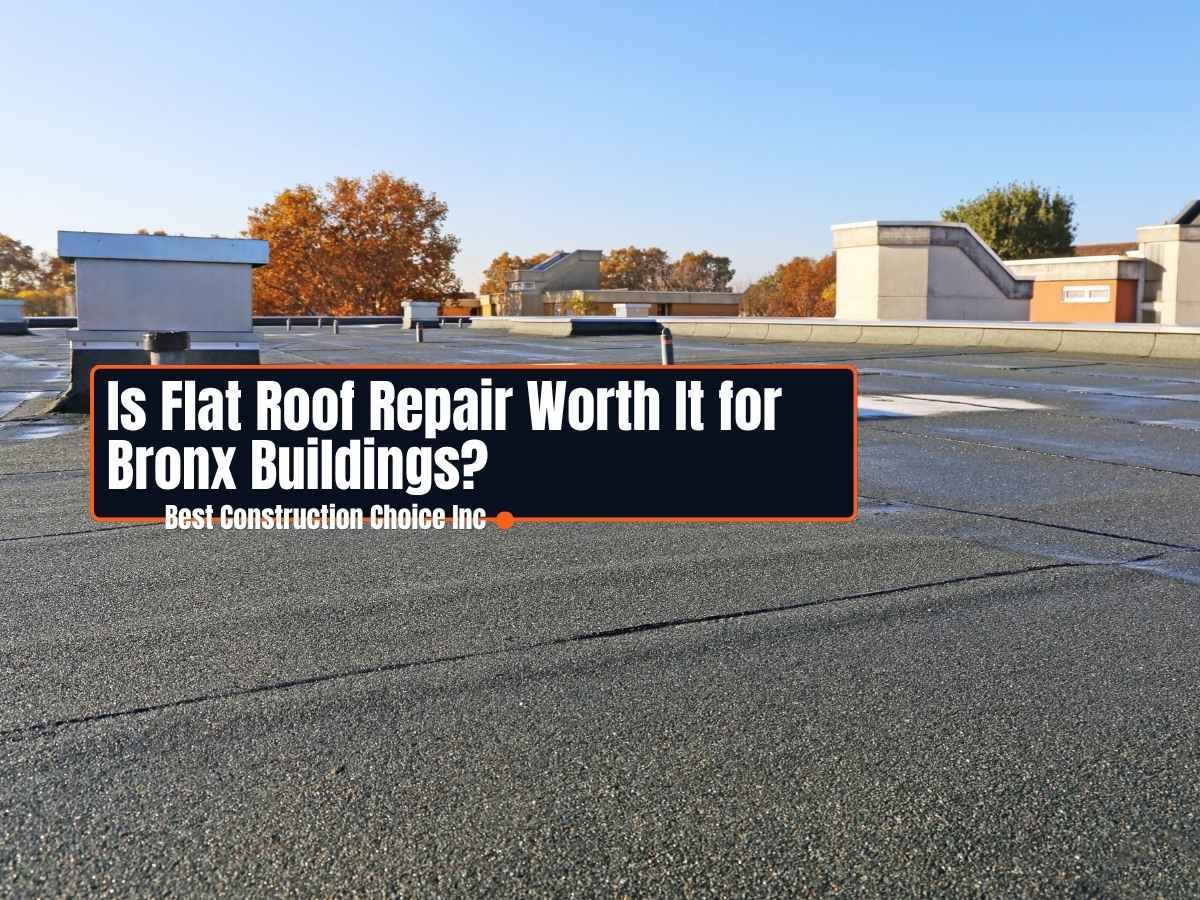
A flat roof isn’t perfectly flat — it typically has a very slight slope designed to direct water toward drains or scuppers. Because there’s little to no pitch, water doesn’t run off quickly the way it does on a sloped roof. That makes flat roofs more sensitive to drainage problems, membrane punctures, and seam failures, since standing water has more opportunity to find its way through any weak point.
Flat roofs are common on multifamily buildings, rowhouses, and commercial properties throughout the Bronx, which is part of why flat roof repair and maintenance questions come up so often here.
When Flat Roof Repair Is Worth It
Repair tends to make sense when the problem is contained and the rest of the roofing system is still doing its job. Situations where repair is often the reasonable choice include:
- A single, localized leak with a clearly identifiable source, rather than water intrusion showing up in multiple areas
- Damaged flashing around a chimney, vent, or roof edge, where the membrane itself is otherwise intact
- Small membrane punctures or tears, often caused by foot traffic, dropped tools, or debris
- Seam separation in one area rather than widespread seam failure across the roof
- Limited, recent water damage that hasn’t had time to spread into decking or insulation
- A roof that’s still within a reasonable portion of its expected lifespan, with no other signs of broader deterioration
In these cases, a targeted repair can resolve the issue and extend the roof’s useful life without the cost of a full tear-off and replacement.
When Replacement May Be the Better Investment
There’s a point where continuing to repair a flat roof stops making financial sense. Signs that replacement is worth considering include:
- Extensive or widespread water damage, rather than damage confined to one area
- Repeated leaks in different locations over a relatively short period
- Severe membrane deterioration — cracking, brittleness, or blistering across large sections of the roof
- Persistent ponding water that doesn’t drain within a reasonable time after rainfall, especially if it recurs in the same spots despite repairs
- Structural concerns, such as sagging or soft spots in the decking
- An aging roofing system nearing or past the upper end of its typical service life for its material type
- Repairs that keep adding up without resolving the underlying issue, which is often a sign the roof’s overall condition — not just one weak spot — is the real problem
If you’ve had the same flat roof repaired multiple times in the same area, that’s usually a signal worth discussing openly with a roofing contractor rather than scheduling yet another patch. If you’re still weighing your options, it can help to read up on deciding between a leak repair and a full replacement before you commit either way.
Flat Roof Repair Costs: What Actually Affects the Price
There’s no single number that applies to every flat roof repair — cost depends heavily on the specific problem, the roofing material, and the extent of the damage. That said, several factors consistently influence pricing:
| Factor | How It Affects Cost |
|---|---|
| Size of the damaged area | Larger or more spread-out damage generally costs more to repair than a single small spot |
| Roofing material | EPDM, TPO, PVC, modified bitumen, and built-up roofing (BUR) all have different repair methods and material costs |
| Accessibility | Roof access, rooftop equipment, and building height can affect labor time |
| Cause of damage | Storm damage, ponding water damage, and general wear may require different repair approaches |
| Emergency vs. scheduled repair | Emergency flat roof repair, especially after storm damage, is often priced differently than a scheduled repair |
| Underlying decking condition | If water has reached the decking or insulation, repair may involve more than just patching the membrane |
Because pricing varies so much by situation, the most reliable way to understand your actual repair cost is a written estimate from a licensed local contractor after an in-person inspection — not a general online estimate.
Repair vs. Replacement: How to Think About the Cost Comparison
A useful way to frame the decision isn’t just “which costs less today” but “which option makes sense over the roof’s remaining useful life.” A repair that costs a fraction of a full replacement might be the obvious choice if it solves the problem. But if you’re facing your third or fourth repair on an aging roof, it’s worth asking your contractor directly: at what point does continuing to repair stop being cost-effective compared to replacing the roof once and starting fresh?
This isn’t a question with a universal answer — it depends on the roof’s age, material, overall condition, and your long-term plans for the property. A contractor who’s willing to walk through that math with you, rather than just pushing toward the more expensive option, is generally a good sign. If you’re not sure a contractor is being straight with you, it’s worth learning how to vet a roofing contractor before hiring so you can compare quotes with confidence.
Common Flat Roof Problems in Bronx Buildings
Certain issues come up repeatedly on Bronx flat roofs, often tied to the building’s age and local weather patterns.
Ponding water. Water that collects and sits for more than a day or two after rain, usually due to inadequate slope, clogged drains, or a low spot that’s developed in the membrane over time.
Drainage failures. Clogged or damaged drains, scuppers, or gutters that prevent water from leaving the roof efficiently, which contributes directly to ponding.
Membrane cracks and punctures. Caused by age, foot traffic, dropped equipment, or exposure to sun and temperature swings over time.
Seam separation. The seams where sections of roofing membrane are joined are common failure points, particularly as the material ages or if the original installation wasn’t done properly.
Flashing deterioration. Flashing around roof edges, chimneys, vents, and rooftop equipment can deteriorate or pull away over time, creating entry points for water.
Storm and wind damage. Heavy storms can lift membrane edges, damage flashing, or deposit debris that punctures the roof surface.
Freeze-thaw damage. In colder months, water that gets into small cracks can freeze, expand, and widen the damage — a cycle that repeats with each freeze-thaw event through the winter.
Many of these issues start small and are easy to miss from ground level, which is part of why it helps to understand the most common causes of roof leaks before they turn into a bigger repair.
Types of Flat Roofing Systems
Not all flat roofs are built the same way, and the material affects both repair approach and expected lifespan.
- EPDM (rubber membrane roofing): A widely used synthetic rubber membrane known for flexibility and relatively straightforward repairs.
- TPO (thermoplastic polyolefin): A reflective single-ply membrane that’s become common on both residential and commercial flat roofs.
- PVC (polyvinyl chloride): Another single-ply membrane option, often chosen for its durability and resistance to certain chemicals or oils.
- Modified bitumen: An asphalt-based roofing system installed in layers, common on older Bronx buildings.
- Built-up roofing (BUR): A traditional multi-layer system using alternating layers of roofing felt and asphalt, still found on many older multifamily and commercial buildings.
- Roof coatings: Applied over an existing membrane to add a protective, often reflective layer — sometimes used as part of a restoration approach rather than a full replacement.
Each system has different repair techniques, so it matters that the contractor you hire has direct experience with your specific roofing material, not just flat roofs in general. If you’re deciding between materials for a replacement, it’s worth first comparing roofing materials for your property to see how each one performs over time.
How to Extend the Life of a Flat Roof
Whether you’re repairing now or trying to delay replacement as long as reasonably possible, ongoing maintenance makes a real difference for flat roofs specifically, since they don’t shed water as readily as sloped roofs.
- Schedule routine inspections, ideally at least once or twice a year and after major storms
- Keep drains, scuppers, and gutters clear of debris so water can actually leave the roof
- Address small leaks and punctures promptly, before they spread or let water reach the decking
- Maintain flashing around roof penetrations, chimneys, and equipment
- Have the roof professionally cleaned periodically to prevent debris buildup
- Consider a protective roof coating where appropriate, as part of a broader maintenance plan
- Keep a maintenance schedule rather than only addressing the roof reactively when a leak appears
If you’re not sure how often your roof actually needs a look, a good starting point is scheduling routine roof inspections rather than waiting for a visible problem to show up.
Bronx-Specific Considerations for Flat Roofs
A few local realities are worth factoring into your decision.
Heavy rainfall and storm exposure. The Bronx sees a full range of seasonal weather, and flat roofs are more exposed to standing water issues during heavy rain than sloped roofs.
Snow and freeze-thaw cycles. Winter weather adds another layer of stress, particularly for roofs that already have minor cracks or seam issues that can worsen through repeated freezing and thawing.
Older multifamily and commercial buildings. Much of the Bronx’s building stock includes older multifamily and commercial properties with flat roofing systems that may be reaching or past the upper end of their expected service life.
NYC building considerations. Depending on the scope of repair or replacement work, permitting requirements through the NYC Department of Buildings may apply — this varies by project, so it’s worth confirming directly with your contractor or DOB rather than assuming.
Roof access and rooftop equipment. Many Bronx flat roofs host HVAC units, vents, or other equipment, which can complicate both inspections and repairs and should be factored into any estimate.
When to DIY and When to Call a Professional
Flat roofs can create the impression that they’re easier to work on than sloped roofs, simply because they’re safer to walk on. That’s true to a point, but most flat roof issues still call for a professional.
Reasonable for a homeowner or property manager to handle:
- Visual inspections from a safe access point, checking for obvious debris, ponding, or visible damage
- Clearing debris from drains and gutters when it can be done safely
Best left to a licensed flat roofing contractor:
- Any membrane repair, patching, or seam work
- Flashing repairs
- Diagnosing the source of a leak, which is often not directly above where the leak appears indoors
- Applying roof coatings
- Any work involving rooftop equipment or structural concerns
- Full or partial roof replacement
Flat roof repair requires material-specific techniques and, done incorrectly, can trap moisture rather than resolve it — which is part of why DIY patches sometimes make a leak worse rather than better.
Related Flat Roofing Services
If you’re evaluating your options, it helps to understand the full range of flat roof services available:
- Rubber flat roof repair and installation
- Roof leak repair
- Emergency roof leak repair
- Storm damage roof repair
- Roof inspection services
- Roof restoration
- Roof replacement
- General roof repair
Frequently Asked Questions
It depends on the extent of the damage and the roof’s overall condition. Localized damage on an otherwise sound roof is usually worth repairing; widespread deterioration, repeated leaks, or persistent ponding often make replacement the more practical long-term choice.
Costs vary based on the size of the damage, the roofing material, and accessibility. A written estimate after an in-person inspection is the most reliable way to get an accurate number for your specific roof.
Lifespan depends heavily on the material (EPDM, TPO, PVC, modified bitumen, or built-up roofing), installation quality, and how well the roof has been maintained over time. Materials and manufacturers vary, so it’s worth asking your contractor about the expected lifespan of your specific system.
Ponding is usually caused by inadequate roof slope, clogged or damaged drains, or a low spot that has developed in the membrane over time. Persistent ponding is worth having evaluated, since standing water accelerates membrane wear.
Often yes, particularly if the leak is localized and the rest of the roof is in reasonable condition. A contractor can assess whether a targeted repair will resolve the issue or whether the roof’s overall condition points toward replacement instead.
This depends on the scope of the work. Some flat roof projects may require a permit through the NYC Department of Buildings, while others may not. A licensed local contractor can help clarify what applies to your specific project.
Not Sure Which Option Is Right for Your Roof?
Every flat roof is different, and the repair-versus-replace decision really comes down to what’s happening on your specific roof. Best Construction Choice Inc provides flat roof repair NYC and Bronx property owners rely on, along with full inspections that give you a clear, honest picture of your roof’s condition before you spend a dollar.
You can view our location on Google Maps or reach out to schedule a flat roof inspection or request a free estimate. Call us at +1 917-916-0676 or +1 203-391-4261, or visit our Roofing Contractor Bronx service page to learn more.