Summer is just around the corner, and for homeowners, landlords, and property managers in the Bronx, NY area, that means one thing: it’s time to get your outdoor spaces ready. Your deck is one of the first places family and guests will gather, but if it has been sitting through a harsh Northeast winter, it may be hiding some serious problems.
Knowing how to repair a damaged deck before summer is not just about appearances. It’s about protecting people from real injuries, maintaining your home’s value, and avoiding the much higher cost of a full deck replacement down the line.
In this complete guide, the experts at Best Construction Choice Inc, your trusted Bronx construction and exterior home improvement specialists walk you through every step, from identifying damage to completing repairs and stunning summer upgrades.
Why You Need to Repair Your Deck Before Summer
Many homeowners put off deck repairs, thinking the damage is cosmetic. That’s a dangerous assumption.
According to the International Association of Certified Home Inspectors (InterNACHI), more than 6,000 people are injured every year in the US due to structural failures on decks, porches, and balconies. The same data shows that around 20% of those injuries are serious enough to require hospitalization.
The North American Deck and Railing Association (NADRA) also reports that roughly 90% of deck collapses occur because of a failure at the connection point between the deck and the house — a problem that often goes completely unnoticed until it’s too late.
Safety Warning: With over 40 million decks in the United States that are more than 20 years old, NADRA estimates that fewer than half of all decks are built to current safety code. If your deck is 15 years old or older, a professional inspection before summer is not optional — it’s essential.
Beyond safety, repairing your deck early pays off financially. According to Remodeling by JLC’s Cost vs. Value Report, wood decks offer a 52.4% return on investment, and composite decks offer about 39.8% ROI nationally. Protecting that investment with timely repairs is simply good homeownership.
Identifying Common Deck Problems
Before you can repair a damaged deck, you need to know what to look for. Walk your deck carefully — and don’t just look at the surface. The most dangerous problems are often underneath.
Top Warning Signs Your Deck Needs Repair
- Soft, spongy, or discolored boards: This almost always means rot has set in. Poke suspicious areas with a screwdriver — if it sinks in easily, the wood is compromised.
- Popped or missing nails and screws: These are tripping hazards and reduce structural stability.
- Wobbly or loose railings: A railing that shifts when you push it is a fall hazard, especially for children and older adults.
- Cracked or warped deck boards: Boards that cup, bow, or split reduce load capacity and create uneven surfaces.
- Gaps between boards that are wider than normal: Boards shrink from weather exposure over time, creating tripping hazards.
- Mold, mildew, or dark staining: Black or green patches signal trapped moisture that will accelerate decay if left untreated.
- Ledger board deterioration: The ledger connects your deck to your house. Check for rot, rust stains from failing fasteners, or missing flashing.
- Shaky or unlevel posts: Posts sitting on soil without concrete footings — or posts that are off-center on their footings — are a structural red flag.
- Corroded metal hardware: Rusty joist hangers, brackets, and bolts are weakening every connection they hold.
Pro Tip from Best Construction Choice Inc: The best time to do a full inspection is on a dry day in early spring — just before you start using the deck again. Check from below the deck as well as on top, and pay special attention to where the deck meets the house wall.
Annual Deck Inspection Checklist
Use this checklist every spring before the summer entertaining season. If you answer “no” or “unsure” to any item, it needs attention.
- Deck surface is free of cracked, warped, cupped, or rotten boards
- All boards are securely fastened — no popped nails or loose screws
- Railings are solid and do not move when pushed with force
- Railing balusters are spaced no more than 4 inches apart (code requirement)
- Railing height meets local code (typically 36–42 inches for residential)
- Stairs are stable, with consistent riser height and secure handrails
- Deck posts are plumb, not rotting, and anchored on concrete footings
- Ledger board is securely bolted to house with proper flashing — no rot or rust
- Joists and beams are free of rot, insect damage, and rust
- Metal hardware (joist hangers, post bases, brackets) shows no significant rust
- No standing water pools on the deck surface after rain
- Deck surface has been sealed/stained within the last 2–3 years
- No visible mold, mildew, or algae growth on boards
- Lighting is functional, and fixtures are weatherproof
- Area under the deck is clear and allows for air circulation
Materials and Tools Needed for Deck Repairs
Essential Tools
- Circular saw or reciprocating saw (for cutting out damaged boards)
- Drill/driver with deck screw bits
- Pry bar or flat bar (for removing old boards)
- Hammer and nail punch
- Speed square and tape measure
- Level (for checking posts and railings)
- Post pounder or concrete form tube (for footing repairs)
- Pressure washer or stiff-bristle scrub brush
- Paint roller, brush, and extension pole (for staining/sealing)
- Safety glasses, work gloves, and knee pads
Common Repair Materials
- Pressure-treated lumber — most affordable option; costs around $2–$3 per square foot
- Cedar — naturally rot-resistant; costs $3–$7 per square foot
- Composite decking — low-maintenance and long-lasting; more expensive upfront
- Deck screws or hidden fasteners — always use corrosion-resistant hardware outdoors
- Joist hangers and metal connectors — Simpson Strong-Tie is the industry standard
- Two-part epoxy wood filler — for minor rot repair in non-structural members ($35–$70/quart)
- Deck cleaner — biodegradable wood deck cleaner for pre-treatment
- Deck sealant or stain — penetrating oil-based or semi-transparent water-based
- Flashing tape or metal flashing — essential for ledger board waterproofing
Step-by-Step Guide to Repairing Deck Boards
Damaged deck boards are the most common repair homeowners encounter. Here is how to replace them the right way.
Step 1 – Identify and mark all damaged boards Walk the entire deck and mark every board that is soft, cracked, cupped, warped, or discolored. Don’t just replace the worst ones — if a board is compromised, replace it fully.
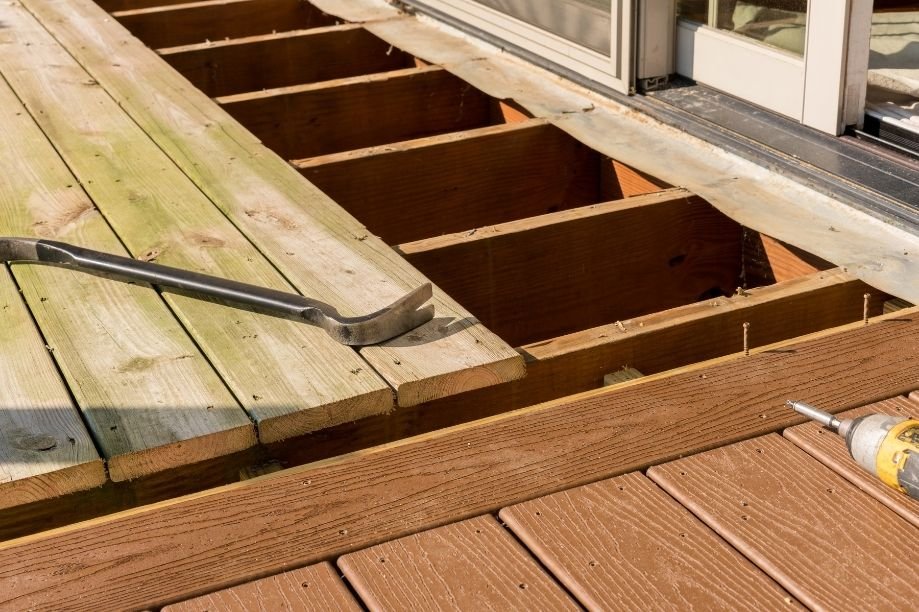
Step 2 – Remove the old boards safely Use a pry bar to lift old boards from the joists. Work carefully to avoid damaging adjacent good boards. If nails are stubborn, use a reciprocating saw to cut through them beneath the board surface.
Step 3 – Inspect the joists underneath With the boards removed, this is your best chance to check every joist for rot, pest damage, and missing hardware. Replace any joist hangers that are rusted. Probe joists with a screwdriver — spongy wood means rot.
Step 4 – Cut your new boards to size Use your circular saw to cut replacement boards to the correct length. Match the width and thickness of your existing decking material for a uniform look. If using pressure-treated lumber, allow it to dry before staining.
Step 5 – Fasten the new boards correctly Use corrosion-resistant deck screws — two per board per joist. Pre-drill to prevent splitting. Maintain consistent spacing between boards (typically ⅛ to ¼ inch) for drainage and expansion.
Step 6 – Sand smooth and prepare for finishing Sand down any rough edges on new boards. Clean the entire deck surface with a deck wash before applying sealer or stain.
Cost Note: According to HomeAdvisor, replacing deck boards costs between $500 and $4,000, depending on size and materials. The national average for a full deck repair is $2,227.
How to Repair or Replace Deck Railing
Deck railing failures are one of the most common causes of deck-related injuries. According to the Pennsylvania Society of Professional Engineers, inadequately fastened railings frequently give way when someone leans against them.
Signs Your Railings Need Attention
- Any movement or wobble when you push the railing firmly
- Visibly rotted, cracked, or split railing posts or balusters
- Loose or missing baluster connections
- Railing height below 36 inches (the minimum residential code in most jurisdictions)
- Baluster spacing wider than 4 inches (a child’s head can become entrapped)
Railing Repair Steps
Step 1 – Test every post and baluster Push each post with force in multiple directions. Any movement means the base connection is compromised. Check where the post is bolted to the deck framing — this is where most failures occur.
Step 2 – Reinforce or replace loose posts Loose post bases are usually caused by failing bolts or rotted wood beneath the post. Replace the hardware with galvanized or stainless steel lag bolts through the framing, not just the deck boards.
Step 3 – Replace damaged balusters Balusters can typically be popped out and replaced individually. Match the material and profile of existing balusters for a uniform look.
Step 4 – Verify code compliance Check that railing height meets local code (36–42 inches standard) and baluster spacing is no wider than 4 inches. Confirm your railing can withstand a 200-pound lateral load as required by most building codes.
Cost Note: Railing repairs typically cost between $500 and $4,000 according to HomeAdvisor.
Tips for Ensuring Deck Stability and Safety
Surface repairs mean nothing if the deck’s skeleton is compromised. These structural checks are the most critical part of pre-summer deck preparation.
Check the Ledger Board Connection
The ledger board is the horizontal member bolted directly to your house’s rim joist. NADRA data shows that roughly 90% of deck collapses happen at this connection point. Look for missing or corroded bolts, water stains, soft wood, or a gap between the ledger and the house. Proper metal flashing must be installed to prevent water infiltration — if yours is missing or failing, this is a top-priority fix.
Inspect Footings and Support Posts
Every post should be anchored to a concrete footing that extends below the frost line. In the Bronx, NY area, that’s typically 36–42 inches deep. Posts sitting directly on soil will rot and shift. Check that posts sit centered on their footings and show no signs of rot at the base.
Examine Joists, Beams, and Hardware
Look beneath the deck for rust on joist hangers, split or cracked beams, and soft spots in any structural member. Replace any hardware that shows significant corrosion. The International Residential Code (IRC) began requiring positive connections between decks and houses in 2009 — older decks often lack this critical safety feature.
Did You Know? According to This Old House, a properly maintained and built-to-code deck should hold 40 pounds per square foot. Overloading at large outdoor gatherings is a documented cause of deck collapses.
Essential Deck Cleaning Tips
A thorough cleaning is the foundation of every good deck repair and maintenance cycle. Dirt, algae, and old sealant must be removed before any stain or sealer is applied — otherwise nothing will adhere properly.
Step 1 – Clear the deck completely Move all furniture, planters, rugs, and grills off the deck. Sweep away loose debris including leaves, dirt, and cobwebs.
Step 2 – Apply a biodegradable deck cleaner Use a cleaner formulated for your material (wood vs. composite). Apply with a stiff-bristle brush or pump sprayer. Let it sit for 15–20 minutes to break down mold spores, algae, grease, and old finish residue.
Step 3 – Pressure wash carefully Use a pressure washer set to 500–1,200 PSI for wood decks. Keep the nozzle moving in the direction of the wood grain. Professional pressure washing costs $200–$450 (HomeAdvisor) and is worth it if you’re not experienced.
Step 4 – Allow full drying time Wood must dry completely — typically 48–72 hours of clear weather — before applying any sealant or stain. Sealing damp wood traps moisture inside and dramatically shortens finish life.
How to Properly Seal and Stain Your Deck
Sealing and staining is the single most effective preventative maintenance step you can take. It blocks UV damage, repels water, and dramatically slows the aging and decay process.
Choosing the Right Product
- Clear sealer: Shows natural wood color; needs reapplication every 1–2 years
- Semi-transparent stain: Adds color while showing wood grain; lasts 2–3 years
- Solid-color stain or paint: Maximum UV and moisture protection; lasts 3–5 years
- Oil-based vs. water-based: Oil-based penetrating stains offer excellent moisture protection; water-based products are more eco-friendly and easier to clean up
Application Tips
- Apply on a dry day with temperatures between 50°F and 90°F — avoid direct hot sun
- Use a brush or roller for flat surfaces; a brush for railings, spindles, and edges
- Apply two thin coats rather than one thick one for better penetration and longevity
- Work in manageable sections and maintain a wet edge to prevent lap marks
- New pressure-treated lumber should weather for 3–6 months before staining
Best Construction Choice Inc Tip: In the Bronx, NY climate — with hot summers and cold, wet winters — we recommend resealing or restaining every 2–3 years minimum. Northeast freeze-thaw cycles are particularly hard on unprotected wood.
Preventing Water Damage to Your Deck
Water is the number one enemy of any wood deck. Chronic moisture causes rot, warping, mold, and structural deterioration. Most water damage is entirely preventable.
Key Prevention Strategies
- Maintain proper board spacing: Boards need ⅛”–¼” gaps for drainage and air circulation. Boards installed too tightly trap water.
- Keep flashing in good condition: Metal flashing between the ledger board and your house wall is the primary defense against water intrusion into your home’s structure. Inspect it annually.
- Ensure good drainage: The deck should slope very slightly away from the house (approximately ⅛ inch per foot) to direct water runoff.
- Trim overhanging vegetation: Leaves and debris that pile up on the deck surface hold moisture against the wood.
- Use proper footings: Posts on concrete footings elevated above ground level using post bases are far less susceptible to rot.
- Consider an under-deck drainage system: Products like DrySpace manage water that gets between boards before it reaches joists.
How to Deal with Mold and Mildew on Decks
Mold and mildew are extremely common on outdoor wood surfaces in humid climates. Left untreated, mold accelerates wood decay, creates slippery surfaces, and can affect air quality near entryways.
Identifying the Problem
- Mildew: Flat, powdery; white or gray; found on the surface. Easier to clean.
- Mold: Fuzzy or slimy; black, green, or brown; penetrates wood fibers. More serious.
- Algae: Green or greenish-black film in shaded, damp areas. Very slippery.
How to Remove Mold and Mildew
Step 1 – Apply a mold-killing deck cleaner Products containing sodium hypochlorite (bleach-based) or oxygen bleach are effective. Apply per manufacturer’s directions and allow adequate dwell time.
Step 2 – Scrub thoroughly Use a stiff-bristle brush to work the cleaner into the wood grain. For composite decking, use a soft brush to avoid scratching.
Step 3 – Rinse completely Pressure wash at low to medium pressure. Ensure all cleaner residue is removed leftover chemicals prevent stain or sealer from bonding.
Step 4 – Treat the wood and seal Once dry, apply a mold-inhibiting deck stain or sealer to prevent regrowth. A product with mildewcide additives is ideal for shaded areas.
Cost Note: Professional mold removal on a deck costs between $200 and $600 (Fixr.com), with averages around $250–$450 for power washing plus treatment.
Deck Upgrades for the Summer Season
Once your deck is structurally sound and clean, make it a space you truly love. Here are the most popular value-adding upgrades — all services offered by Best Construction Choice Inc.
Add Deck Lighting
String lights, recessed step lights, post cap lights, and under-rail LED strips extend evening use and dramatically enhance ambiance. Low-voltage LED systems are energy-efficient and create a warm atmosphere. Step lights integrated into stair risers are especially important for safety.
Install a Pergola or Awning for Shade
A pergola or retractable awning provides shade, defines your outdoor “room,” and increases time you can comfortably use the deck on hot days. Retractable awnings offer full flexibility — shade on hot days, full sun when you prefer it.
Add a Deck Heating System for Cooler Evenings
In the Bronx area, spring and fall evenings can be chilly even when days are warm. Wall-mounted or ceiling-mounted infrared patio heaters provide effective, directional warmth. A gas or wood-burning fire pit table makes the deck a natural gathering point from spring through late autumn.
Create Outdoor Furniture Zones
Define dining and lounge areas with strategic furniture placement. Weather-resistant teak, aluminum, or all-weather wicker are excellent choices for the Northeast climate.
Add Privacy Screening
Lattice panels, bamboo screens, or horizontal slat fencing between posts create privacy and reduce wind without fully enclosing the space.
Install Built-In Seating and Storage
Built-in benches along the perimeter maximize seating capacity and can be designed with hidden storage compartments underneath, great for cushions, grilling tools, and outdoor accessories.
Deck Repair Cost Breakdown (2025)
| Repair Type | Cost Range | Average |
|---|---|---|
| Full deck repair | $866 – $3,587 | $2,227 |
| Board replacement | $500 – $4,000 | $1,500 |
| Railing repair/replacement | $500 – $4,000 | $1,800 |
| Rotted wood repair | $200 – $500 | $350 |
| Mold/mildew treatment | $200 – $600 | $350 |
| Pressure washing | $200 – $450 | $290 |
| Stair repair (per step) | $15 – $50 | $30 |
| Deck sealing/staining | $300 – $900 | $550 |
| Ledger board repair | $300 – $1,000 | $600 |
Sources: HomeAdvisor, Thumbtack, Fixr.com (2025). NYC/Bronx area labor rates may be higher than national averages. Call +1 203-391-4261 for a free local estimate.
Frequently Asked Questions (FAQ)
A repair is usually the right call if the damage is localized, your deck is less than 15 years old, and the structural framing is sound. According to HomeAdvisor, if repair costs exceed half the price of a new deck or if your deck is 15+ years old with widespread rot or structural failure — replacement is the smarter long-term investment. A professional inspection from Best Construction Choice Inc can help you decide with confidence.
Based on 2025 data from HomeAdvisor and Thumbtack, the average cost to repair a deck nationally ranges from about $866 to $3,587, with a mean around $2,227. In the New York metro area, labor costs tend to be higher than national averages. Call us at +1 203-391-4261 for a free on-site estimate.
Early spring, right after the last freeze but before heavy summer use. In the Bronx, NY area, mid-April through May is typically the sweet spot. This gives new wood time to dry before staining and ensures your deck is safe before the entertaining season begins.
Can I repair a deck myself, or do I need a professional?
Minor surface repairs — replacing a single board, tightening screws, applying sealant — are manageable DIY projects. However, any work involving structural elements (ledger board, posts, beams, footings), railings that must meet code, or work requiring a permit should be handled by a licensed professional. Incorrectly repaired structural components can make a deck more dangerous than before the repair.
Does homeowner’s insurance cover deck damage?
Homeowners insurance typically covers sudden, unexpected damage — fire, storms, falling trees. Damage from normal wear, rot, or mold is generally not covered. If your deck is attached to your home, it usually falls under “dwelling” coverage. Review your specific policy with your agent and document damage with photos before and after any storms.
How do I prevent deck boards from warping or cupping?
Seal all six sides of every board before installation, maintain proper board spacing (⅛”–¼”) for drainage and air circulation, and reapply sealant every 2–3 years. Keep the area beneath the deck well-ventilated.
How often should I seal or stain my deck?
Most wood decks need resealing every 2–3 years. A simple water test tells you when it’s time — sprinkle water on the surface. If it beads up, the sealant is still working. If it soaks in immediately, it’s time to reseal. Composite decking only needs occasional cleaning and does not require sealing.
Do I need a permit to repair my deck in the Bronx, NY?
In New York City — including the Bronx — permits are generally required for structural deck work, full replacements, and significant modifications. Like-for-like cosmetic maintenance typically does not require a permit. Always check with the NYC Department of Buildings. Best Construction Choice Inc is fully familiar with local code and can manage the permitting process for you.
What are the signs of serious structural deck damage?
The deck bounces or flexes noticeably when walked on; posts lean, twist, or have soft spots at the base; visible gaps or movement at the ledger board connection; beams or joists that sag or show tunneling (termite damage); visible separation between the deck and the house. If you notice any of these, stop using the deck and call a professional immediately.
How long does a deck last with proper maintenance?
According to This Old House, the average deck lasts 15–20 years. With diligent annual maintenance — cleaning, resealing, prompt repairs, and regular inspections — well-built wood decks can last 25–30 years or more. Composite decks are engineered for 25–30+ years.
When to Hire a Professional Deck Contractor in the Bronx, NY
DIY-Appropriate Tasks
- Hammering down or replacing popped nails and screws
- Replacing one or two isolated surface boards
- Cleaning and applying sealant or stain
- Replacing individual balusters (if posts are secure)
- Installing solar-powered deck lighting
Always Hire a Professional For
- Any ledger board repair or flashing replacement
- Replacing or repairing posts, beams, or joists
- Footing repairs or replacement
- Full railing system replacement (to ensure code compliance)
- Repairs on elevated decks (second story and above)
- Decks with widespread rot or termite damage
- Any work that requires a building permit
- Full deck replacement or major renovation
Hiring a professional gives you access to warranties on workmanship, proper insurance coverage, and the assurance that all work meets current building codes, protecting you legally and financially as a homeowner, landlord, or property manager.
About Best Construction Choice Inc
With 15 years of hands-on experience, Best Construction Choice Inc is your trusted Bronx, NY construction and exterior home improvement partner. We specialize in roofing, siding, gutters, chimneys, decks, concrete, masonry, skylights, and railings — delivering durable, professional craftsmanship tailored to your needs.
We proudly serve the Bronx and all surrounding neighborhoods with reliable, affordable results and a focus on long-lasting quality.
📞 +1 203-391-4261 🌐 bestconstructionchoiceinc.com 📍 Bronx, NY and all nearby areas ✅ Licensed & Insured | Free Estimates | 15 Years of Experience