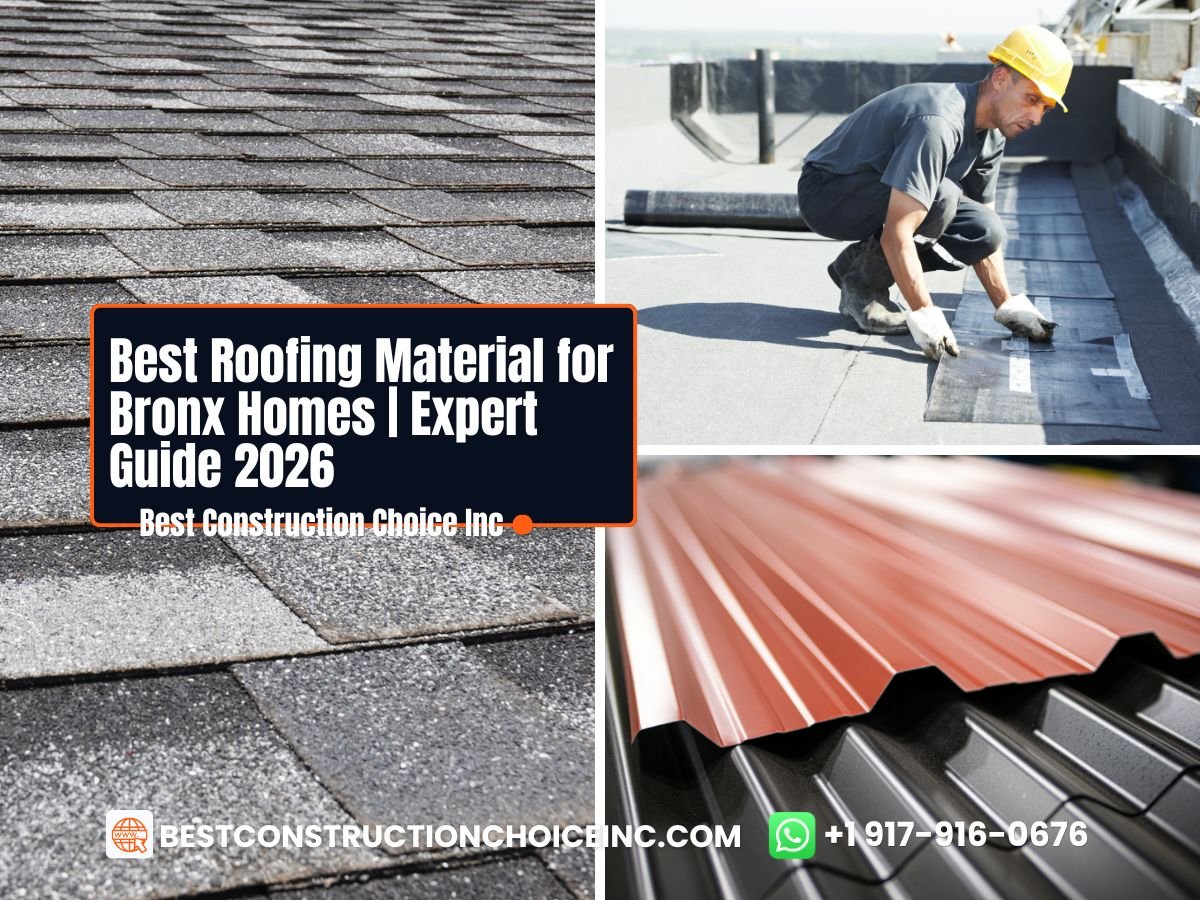
If you’re planning a roof replacement, what is the best roofing material for your Bronx property really depends on your budget, your roof type, and how much punishment your roof takes from Bronx weather each year. There’s no single “best” answer for every home. A flat-roofed multi-family building in Fordham needs a different solution than a pitched-roof single-family home in Throggs Neck.
At Best Construction Choice Inc, we install and repair roofs across the Bronx and Westchester County every day. Our licensed and insured team has seen which materials hold up here and which ones fail early. This guide breaks down the top roofing materials available in 2026, what they cost, how they perform in Bronx weather, and how to choose the right one for your property.
Quick Answer: Best Roofing Materials for Bronx Homes
For most Bronx single-family and row homes, architectural asphalt shingles remain the best all-around choice in 2026, balancing cost, style, and a 20–30 year lifespan. Homeowners planning to stay long-term, or who want maximum durability against wind and snow, should consider standing seam metal roofing, which lasts 40–70 years. For the flat and low-slope roofs common on Bronx multi-family buildings, TPO or EPDM membrane roofing is the standard choice. We break down the full comparison below.
Best Roofing Materials for Bronx Homes in 2026
Pros and Cons of Popular Roofing Materials
Asphalt Shingles: Asphalt shingles are still the most widely installed roofing material in the country, and for good reason. They’re affordable, come in dozens of colors and styles, and are quick to install.
- Pros: Lower upfront cost, wide style selection, easy repairs, fast installation.
- Cons: Shorter lifespan than metal or slate. More vulnerable to wind uplift and granule loss over time. Performance depends heavily on installation quality and attic ventilation.
Metal Roofing: Metal roofing has grown quickly in popularity as homeowners look for longer-term durability. Metal panels interlock, which creates a continuous surface with far fewer seams for wind to grab compared to individual shingles.
- Pros: Long lifespan (40–70 years), excellent wind resistance, reflects summer heat, recyclable at end of life.
- Cons: Higher upfront installation cost, and it may not suit every home’s architectural style, though textured panels now closely mimic slate or wood shake.
TPO and EPDM (Flat Roof Membranes) Many Bronx multi-family buildings, row houses, and additions have flat or low-slope roofs, which asphalt shingles and metal panels aren’t designed for. TPO (thermoplastic polyolefin) and EPDM (synthetic rubber) membranes are the standard solutions.
- Pros: Purpose-built for flat roofs, strong waterproofing, white TPO reflects heat and can lower cooling costs.
- Cons: EPDM’s taped seams are weaker than TPO’s heat-welded seams. Both require professional installation to reach their full rated lifespan.
Synthetic Slate and Composite Shingles Composite and polymer-based shingles are gaining favor for their durability and lightweight properties, while closely mimicking the look of natural cedar or slate.
- Pros: Long lifespan, lighter weight than real slate, resistant to moisture and impact.
- Cons: Higher cost than standard asphalt shingles; fewer local installers are experienced with the material.
Latest Trends in Roofing for 2026
Roofing in 2026 is shifting toward durability, sustainability, and energy performance. Several trends stand out:
- Durability is now a top priority. As extreme weather becomes more common, homeowners are looking for durable roofing materials, like impact-resistant shingles, that can withstand harsher weather.
- Sustainability has moved from a buzzword to a deciding factor. Recyclable metal roofing, reclaimed clay tiles, and composite shingles made from recycled content are all gaining ground with property owners.
- Cool roofs and reflective materials are more accessible. Solar-reflective shingles and coatings, once mostly used in hot Southern climates, are now more common and more affordable nationwide.
- Synthetic and flat-roof-style materials are rising. Flat roofs and synthetic roofing styles have seen a 41% increase in sales, thanks to their versatility, modern look, and long-term value.
- Solar-ready roofing is expanding. More manufacturers now design metal panels and shingles specifically to support solar panel mounting without voiding warranties.
For Bronx homeowners, the practical takeaway is this: durability and energy performance are becoming standard expectations, not upgrades.
Cost Analysis of Roofing Materials in the Bronx
Here’s how the major roofing materials compare on installed cost per square foot, based on current national pricing data:
| Material | Installed Cost (per sq. ft.) | Typical Lifespan |
|---|---|---|
| Asphalt shingles (architectural) | $4 – $11 | 20–30 years |
| Standing seam metal | $9 – $18 | 40–70 years |
| TPO membrane | $5 – $12 | 15–30 years |
| EPDM membrane | $4 – $8 | 20–30 years |
| Synthetic slate/composite | Higher than standard asphalt | 30–50 years |
For a typical single-family Bronx home with an asphalt shingle roof, total project cost commonly falls in the $9,000–$18,000 range. Bronx pricing tends to sit at the higher end of national ranges because of NYC labor rates, building density, and DOB permitting requirements. Flat-roof buildings should budget by total roof square footage. A 1,500 sq. ft. flat roof section, for example, typically runs $6,000–$15,000 installed with TPO, EPDM, or modified bitumen.
The only way to get an exact number for your property is a free, in-person estimate, which Best Construction Choice Inc provides on every project.
Eco-Friendly Roofing Options for Bronx Homes
Sustainability is a growing factor in material selection. A few standout options for Bronx properties:
- Cool roof shingles, which use specially coated granules to reflect more sunlight. To be Energy Star compliant, a shingle must have an initial solar reflectance of at least 0.25, with an aged reflectance of at least 0.15.
- White TPO membranes, which meet Energy Star and Cool Roof Rating Council standards and are widely used to reduce cooling loads on flat-roofed buildings.
- Recyclable metal roofing, much of which can be recycled again at the end of its service life.
- Green (vegetated) roof systems, which are increasingly popular in dense urban areas because they manage stormwater, reduce heat, and improve air quality — a good fit for some Bronx multi-family buildings.
Factors to Consider When Choosing a Roofing Material
Before choosing a material, weigh these factors against your specific property:
- Roof pitch. Steep-slope roofs can use shingles, metal, or tile. Flat and low-slope roofs need membrane systems like TPO or EPDM.
- How long you plan to own the property. Shorter ownership horizons often favor lower-cost asphalt shingles, while long-term owners benefit more from metal’s 40–70 year lifespan.
- Budget, both upfront and lifetime. A cheaper material with a shorter lifespan can cost more per year of service than a pricier, longer-lasting one.
- Building type. Multi-family and row houses often have different structural and drainage needs than detached single-family homes.
- Energy goals. If lowering summer cooling costs matters to you, reflective or cool-roof-rated materials are worth the conversation.
- NYC and local code compliance. Your material choice needs to meet current building code and, where applicable, local sustainability rules.
Comparing Different Roofing Materials Available in 2026
Comparative Guide: Asphalt Shingles vs. Metal Roofing
This is the most common comparison Bronx homeowners ask us about, so here’s a direct side-by-side:
| Factor | Asphalt Shingles | Metal Roofing |
|---|---|---|
| Upfront cost | Lower | Higher |
| Lifespan | 20–30 years (architectural) | 40–70 years |
| Wind resistance | Class F (110 mph) to Class H (150 mph), depending on product | Often 140 mph or higher |
| Maintenance | Moderate | Low |
| Heat reflection | Improves with cool-roof-rated products | Naturally reflective, especially light colors |
| Installation | Nailed, faster installation | Screwed panels, interlocking seams |
| Best for | Budget-conscious replacements, most single-family homes | Long-term owners, high-wind exposure, energy savings |
Metal roofing’s interlocking panel design and screw-based installation give it a real durability edge over individual shingles, which is part of why insurance carriers increasingly favor it in storm-prone regions. That said, for most Bronx single-family homes, high-quality architectural asphalt shingles still deliver the best balance of cost and performance.
Longevity and Durability of Roofing Materials
- 3-tab asphalt shingles: 15–20 years
- Architectural asphalt shingles: 20–30 years
- TPO membrane: 15–30 years, depending on thickness and installation
- EPDM membrane: 20–30 years, with some systems reaching 30+ years with excellent maintenance
- Standing seam metal: 40–70 years
- Synthetic slate/composite shingles: 30–50 years
- Natural slate/tile: 75–100+ years
Installation quality determines longevity more than material choice alone. The best material in the world underperforms when it’s poorly installed, which is why hiring an experienced, licensed local contractor matters as much as the material itself.
Weather Resistance of Various Roofing Options
Wind resistance for asphalt shingles is measured through standardized testing. Shingles are rated on a scale of Class A (60 mph) up to Class H (150 mph), based on ASTM D3161 and ASTM D7158 wind-resistance testing. Basic 3-tab shingles typically carry the lowest ratings, while premium architectural shingles often achieve Class F (110 mph) or Class H (150 mph) ratings.
Metal roofing generally outperforms shingles in wind resistance because its interlocking panels and concealed fasteners create a continuous surface with far fewer points for wind to catch. Many standing seam metal systems are rated at 140 mph or higher.
For flat roofs, membrane performance depends heavily on seam quality. TPO’s heat-welded seams generally outperform EPDM’s taped or glued seams under wind and thermal stress, though EPDM remains a proven, budget-friendly option with a track record going back more than 50 years.
Installation Tips for Different Types of Roofing
- Asphalt shingles: Proper attic ventilation is critical. Poor ventilation shortens shingle life regardless of product quality.
- Metal roofing: Panel alignment and fastener placement matter more than with shingles. Hire a contractor experienced specifically with metal systems.
- TPO/EPDM: Seam quality is the single biggest factor in long-term performance. Heat-welded TPO seams generally hold up better than taped EPDM seams over time.
- All materials: Confirm your contractor pulls the required NYC Department of Buildings permit before work begins, since unpermitted roofing work can lead to a Stop Work Order and fines.
Finding the Right Roofing Contractor in the Bronx
Material selection only matters if the installation is done correctly. Before hiring a contractor for your Bronx roofing project, confirm:
- A valid NYC Home Improvement Contractor (HIC) license.
- Proof of general liability and workers’ compensation insurance.
- Local experience with NYC Department of Buildings permitting, including Alt-2 and Alt-3 filings.
- Written estimates with material specifications, not vague verbal quotes.
- A real local track record, not just a company that happens to service “the tri-state area.”
Best Construction Choice Inc is a licensed and insured roofing contractor serving Bronx neighborhoods and Westchester County. We provide free estimates and clear communication from the first inspection through project completion.
Roofing Materials That Stand up to Bronx Weather in 2026
Impact of Climate on Roofing Material Selection
The Bronx sits in a humid subtropical climate zone, with cold, snowy winters and hot, humid summers. That combination puts two very different types of stress on a roof every year: winter freeze-thaw cycling and summer heat and UV exposure. Materials that perform best here typically share a few traits: strong wind and moisture resistance, minimal thermal expansion and contraction, and stable performance across a wide temperature range.
Heat-Reflective Roofing Materials for Bronx Summer
Cool roofing has become one of the most practical upgrades available for Bronx homes and buildings. According to the Lawrence Berkeley National Lab Heat Island Group, a clean white roof that reflects 80% of sunlight stays about 50°F cooler on a typical summer afternoon than a grey roof reflecting only 20%. Solar-reflective (“cool”) asphalt shingles use specially coated granules that reflect more infrared radiation, which can lower roof surface temperatures by 50–60°F compared to standard shingles. For flat-roofed Bronx buildings, white TPO membranes provide a similar benefit, meeting Energy Star and Cool Roof Rating Council reflectance standards.
While cool roofing delivers its biggest energy savings in hot Southern climates, the benefit in Northern climates like the Bronx is still real, and it’s expected to grow as regional summers get hotter. Cool roofs also reduce long-term thermal stress on the material itself, which can extend the roof’s service life.
Winter-Proof Roofing Solutions
Winter is the toughest season for a Bronx roof. Snow load and repeated freeze-thaw cycling put constant mechanical stress on shingles, flashing, and roof decking, since water that seeps into small cracks during a thaw can freeze and expand overnight. Materials that hold up best through Bronx winters include:
- Architectural asphalt shingles with a high wind rating (Class F or H), which resist uplift during winter storms.
- Standing seam metal roofing, which sheds snow effectively and resists ice-dam-related damage better than shingles.
- Properly installed TPO or EPDM membranes on flat roofs, paired with adequate drainage to prevent standing water from freezing and expanding.
Maintaining Your Roof Through Extreme Weather
Regardless of material, a few maintenance habits extend roof life through Bronx’s toughest seasons:
- Schedule a professional inspection at least once a year, ideally twice: once in spring and once in fall.
- Add an extra inspection after any major storm, nor’easter, or heavy snow event.
- Keep gutters and roof drains clear to prevent water backup and ice dams.
- Trim overhanging branches that can drop debris or scrape roofing material.
- Address minor repairs quickly. Small issues left unaddressed through a Bronx winter often turn into major ones by spring.
Hurricane-Resistant Roofing Options
While the Bronx isn’t in a hurricane-prone coastal zone the way parts of the Gulf Coast or Florida are, it does see high-wind nor’easters and severe storm events that call for genuinely wind-resistant materials. For homeowners who want maximum wind protection:
- Class H-rated asphalt shingles are tested to withstand winds up to 150 mph under ASTM D7158 testing.
- Standing seam metal roofing is often wind-rated at 140 mph or higher, due to its interlocking panel design and screw-based fastening.
- Impact-resistant shingles are increasingly popular as extreme weather becomes more common, helping homeowners avoid costly repairs after severe storms.
Choosing a higher wind-rated material is a straightforward way to reduce storm damage risk and potentially qualify for better insurance terms, since many insurers now offer premium discounts for properly rated roofing systems.
Frequently Asked Questions
For most single-family and row homes, architectural asphalt shingles offer the best balance of cost, style, and durability, typically lasting 20–30 years. Homeowners planning to stay long-term or wanting maximum durability often choose standing seam metal roofing, which can last 40–70 years.
Natural slate and tile last the longest, at 75–100+ years, though they come at a premium cost and structural weight requirement. Among more common options, standing seam metal roofing offers the longest lifespan at 40–70 years.
For homeowners planning to stay in their property long-term, metal roofing is often worth the higher upfront cost. It lasts roughly twice as long as asphalt shingles, handles snow and wind better, and can lower summer cooling costs due to its reflective surface.
TPO and EPDM membrane systems are the standard choices for flat and low-slope roofs, which are common on Bronx multi-family buildings. TPO offers stronger heat-welded seams and better reflectivity, while EPDM offers a lower upfront cost and a proven, decades-long track record.
How much does a new roof cost in the Bronx?
Asphalt shingle roof replacement typically costs $9,000–$18,000 for a single-family home, while flat roof replacement with TPO or EPDM commonly runs $6,000–$15,000 for a 1,500 sq. ft. section. A free, in-person estimate is the only way to get an exact number for your property.
What roofing material is best for hot summers and cold winters?
Materials with strong reflectance and wind resistance perform best in a climate like the Bronx’s, which sees both hot, humid summers and cold, snowy winters. Cool-roof-rated asphalt shingles, standing seam metal, and white TPO membranes all handle this seasonal swing well.
Do eco-friendly roofing materials cost more?
Some, like recyclable metal roofing or cool-roof-rated shingles, cost more upfront but often pay off over time through lower cooling costs and longer lifespans. Others, like standard EPDM membranes, are already among the most affordable options available.
Serving Bronx Neighborhoods and Westchester County
Best Construction Choice Inc provides expert roofing, deck, gutter, chimney, and siding services throughout the Bronx and Westchester County, NY. Our licensed and insured team specializes in roof installation, roof repair, and custom deck building, backed by quality craftsmanship and clear communication from estimate to completion.
Not sure which roofing material is right for your property? Get a free, no-obligation estimate from a local team that knows how Bronx weather affects every material on this list.
Call Best Construction Choice Inc today: 📞 Main: +1 917-916-0676 📞 Secondary: +1 203-391-4261 🌐 bestconstructionchoiceinc.com
Free estimates available. Serving Bronx neighborhoods and Westchester County homeowners.