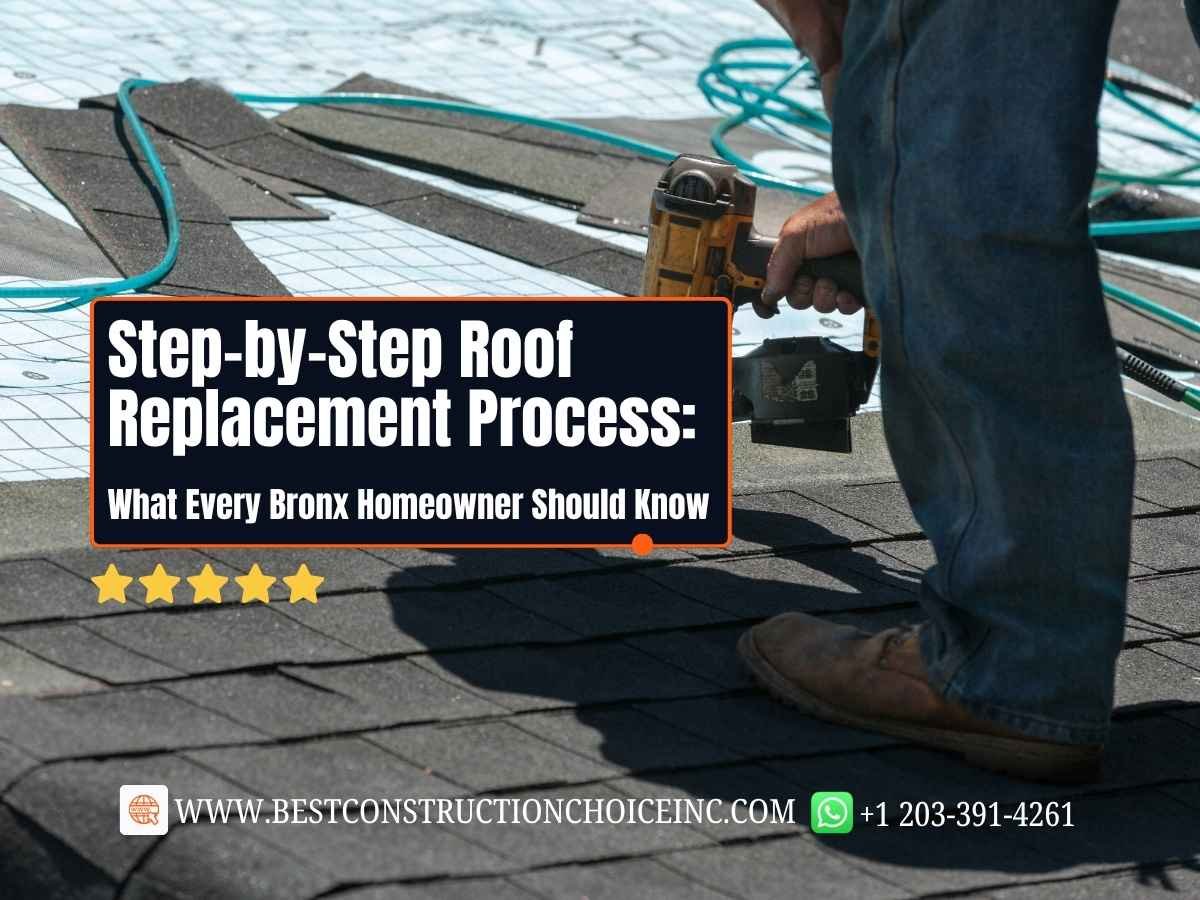
Why Understanding the Roof Replacement Process Matters
Getting a new roof is one of the biggest home investments a Bronx homeowner, landlord, or property manager will ever make. Yet most people go into it without knowing what actually happens from day one to final cleanup.
That gap in knowledge is expensive. It leads to missed red flags, poor contractor choices, surprise costs, and voided warranties.
This step-by-step roof replacement process guide changes that. We wrote it specifically for Bronx, NY homeowners — where brownstones, flat roofs, multi-family buildings, and NYC Department of Buildings (DOB) permit rules create a unique local context. Every step here reflects real, verified industry practices — not guesswork.
By the time you finish reading, you’ll know exactly what to expect, what questions to ask, and how to protect your investment from day one through the life of your new roof.
Initial Roof Inspection and Assessment
The roof replacement process starts before any materials arrive or permits get pulled — it starts with a professional inspection.
A licensed roofing contractor performs a thorough examination of your current roof to determine its true condition and whether replacement is truly necessary (vs. a targeted repair).
What a Professional Bronx Roof Inspection Covers
Exterior Ground-Level Observation Before the inspector even climbs up, they assess the roof from the ground — looking at edge conditions, visible sagging, ponding water evidence on flat roofs, and drainage outlet positions.
Roof Surface Evaluation The inspector walks the accessible roof area, examining membrane condition, granule loss, blistering, cracking, and standing water evidence. For Bronx flat roofs, inspectors may also use infrared thermography to detect subsurface moisture that the naked eye cannot see.
Structural Deck Assessment The inspector checks the roof deck and underlayment for sagging, water damage, soft spots, and rot. Finding deck issues early is critical — the crew must replace damaged boards before installing any new roofing material.
Flashing and Penetration Inspection The inspector examines all flashings at walls, chimneys, curbs, skylights, HVAC equipment bases, and pipe penetrations for separation, corrosion, cracking caulking, and improper installation. Flashing failures are among the most common causes of roof leaks.
Drainage Assessment The inspector checks interior drains, scuppers, gutters, and downspouts for blockage, proper slope, and code compliance — especially important for Bronx flat roofs, where drainage failure leads directly to ponding and membrane damage.
Attic Inspection If accessible, the inspector examines the attic space for signs of leaks such as water stains or mold, and assesses insulation and ventilation for adequacy. Poor attic ventilation shortens the lifespan of any roofing material.
What You Receive After the Inspection
A professional inspection should result in a detailed written report that includes photographic documentation, a clear condition summary, and an honest recommendation – replacement, repair, or routine maintenance. Reputable contractors do not pressure homeowners into replacement if repair is genuinely the right solution.
Best Construction Choice Inc provides free roof inspections and honest written estimates — no pressure, no upselling, no hidden fees. Call +1 203-391-4261 to schedule yours.
Permits, Insurance & Material Selection
Once the inspection confirms a replacement is needed, three things happen before a single shingle is touched.
Permits
In New York City, including the Bronx, roofing permits are required for structural deck replacement, changing roof type, commercial buildings, and projects that trigger NYC Local Laws 92/94. Only a licensed contractor can pull a DOB permit — not the property owner.
The contractor files the permit through NYC DOB NOW Build. Simple like-for-like replacements may not require a permit under NYC AC §28-105.4, but your licensed contractor will make this determination and handle all filings.
⚠️ Never hire a contractor who skips permits to cut your quote. If an inspector discovers unpermitted work — especially at resale — fines and DOB violations fall on the property owner, not the contractor.
Insurance Review
Before the project starts, review your homeowner’s insurance policy. Most standard policies cover roof damage from sudden events — storms, hail, wind, and falling debris. Damage from age or gradual wear typically falls outside coverage. If the damage qualifies, document it with photos and contact your insurer before repair or replacement work begins.
Material Selection
Your contractor will walk you through material options appropriate for your roof type and building. For Bronx homeowners, this generally means:
- Flat roofs → EPDM, TPO, or modified bitumen
- Pitched roofs → Architectural asphalt shingles, metal roofing, or tile
- Historic or landmark buildings → May require Landmarks Preservation Commission (LPC) approval before finalizing materials
This stage is also when contractors evaluate NYC Local Law 92/94 sustainable roof requirements — full replacements on most Bronx buildings require a sustainable roof zone (solar panels, green roof, or a combination).
Preparing Your Home for Roof Replacement
Roof replacement day goes far more smoothly when you prepare your home in advance. A little planning protects your property, reduces stress, and helps the crew work efficiently from the start.
Outdoor Preparation Checklist
Move all vehicles out of the driveway the night before. Material deliveries often arrive before you wake up, so relocate cars to the street or a neighbor’s driveway.
Clear the perimeter. Remove patio furniture, grills, potted plants, children’s toys, lawn decorations, and any outdoor items within 15 feet of the house. This protects them from falling debris and gives the crew clear, safe access.
Protect landscaping. Cover shrubs or delicate plants near the house with tarps or plywood to shield them from falling materials. Additionally, trim back any trees or shrubs that overhang the roofline before the crew arrives.
Mow the lawn. Short grass makes it much easier to spot and collect stray nails and debris after the job is complete.
Mark irrigation heads and garden lights to prevent tripping or damage during material handling.
Photograph the property. Take photos of your driveway, landscaping, patio, and roofline before work starts. These images give you a clear visual record if any questions arise about pre-existing conditions.
Indoor Preparation Checklist
Cover attic storage. Vibrations from hammering and material movement on the roof can shake dust and debris down into attic spaces. Cover stored items with plastic sheeting or old sheets.
Remove wall-mounted items. Roofing vibrations travel through the structure of the house. As a precaution, take down framed photos, mirrors, and floating shelves — especially on upper floors and in rooms directly below the roofline.
Move fragile items away from walls or to safer rooms on lower floors.
Plan for pets. Roofing noise often distresses animals. Plan to keep sensitive pets indoors in a quiet space or temporarily off-site during the loudest portions of the project.
Notify your neighbors 2–3 days in advance. If you share a driveway or live close to neighboring homes, coordination helps prevent blocked access and avoids surprises.
Identify outdoor electrical outlets. Roofing crews need power for their tools. Letting them know where the closest outdoor outlet is helps the project start smoothly.
Material Delivery and Site Setup
The first physical step of your actual roof replacement process is material delivery — typically the afternoon before or the morning of the project.
A reputable roofing contractor will never deliver materials multiple days in advance unless bad weather delays the project start. The crew unloads materials on a paved surface near the roof access point in a dry area. If shingle pallets land directly on grass, you’ll end up with dead patches — a clear sign of careless site management.
Delivery size depends on your roof size, measured in “roofing squares” (1 square = 100 sq ft of roof area), and the materials the crew will install.
What Site Setup Includes
- Setting up safety equipment, debris chutes, and protective coverings around the property
- Positioning dumpsters or material drop zones for tear-off debris
- Protecting landscaping, driveways, and entry points with tarps or plywood
- Briefing the crew on property-specific concerns you’ve noted
Roof Tear-Off and Removal
With the site prepared, the crew begins the tear-off. This phase is often the loudest and most visually dramatic part of the roof replacement process.
What Happens During Tear-Off
Removing the old roofing material. Using specialized roofing shovels and tear-off forks, the crew systematically strips old shingles, tiles, or membrane material, starting at the ridge and working down. Workers direct debris into chutes or dumpsters to protect the yard below.
Removing the underlayment. Beneath the shingles lies felt or synthetic underlayment, which the crew also removes to expose the roof deck. This step is critical — it’s the first opportunity to spot hidden moisture damage that wouldn’t be visible from above.
Replacing flashing and vents. During tear-off, workers remove chimney flashing, plumbing boots, and roof vents. On a proper replacement, the crew installs new components — rather than reusing old ones. Reused flashing is a common cost-cutting shortcut that leads to leaks.
Cleaning the deck. Finally, the crew sweeps the exposed deck clean, hammers down or removes protruding nails, and prepares the surface for new installation.
Roof Deck Inspection and Repairs
With the old roofing fully removed, the roof deck is now completely exposed. This moment is a critical inspection point in the roof replacement process.
The crew inspects every inch of the decking — the plywood or OSB sheathing that forms the structural base of your roof — for soft spots, rot, water damage, sagging, and warping. Any compromised decking must be replaced before the crew installs new materials.
The 25% Rule
Under many building codes, if inspection reveals that more than 25% of the existing roof deck has suffered damage, the code requires a full deck replacement rather than spot repairs. This standard ensures the new roofing system rests on a solid, reliable foundation.
What Deck Repair Costs
Deck repair is an additional cost that contractors cannot always quote upfront — it depends on what the crew finds once they remove the old roof. Replacing damaged decking typically adds $0.43–$1.80 per sq ft to the project cost. A trustworthy contractor will show you damaged sections before replacing them and document the repair in writing.
Underlayment, Ice & Water Shield, and Flashing
Before a single new shingle or membrane goes on, the crew must install the proper waterproofing layers. These hidden layers form the true foundation of a long-lasting Bronx roof.
Ice and Water Shield
In cold climates like the Bronx, the crew installs ice and water shield along the eaves (at least 3 feet up from the roof edge) and in all valleys. This self-adhesive membrane prevents ice dam damage — a serious and common issue in New York winters. Ice dams form when heat escapes through the roof, melting snow that then refreezes at the eaves and forces water under shingles and into the structure.
In addition, the crew applies ice and water shield around all penetrations — vents, chimneys, and skylights — for a fully watertight seal.
Underlayment
Over the rest of the roof deck, the crew rolls out synthetic underlayment horizontally, starting at the bottom edge. Each row overlaps by 6 inches and the workers secure it with cap nails or staples. Synthetic underlayment outperforms traditional felt paper because it resists tearing in wind and provides superior water resistance.
Drip Edge Flashing
The crew installs metal drip edge flashing along the eaves and rake edges to channel runoff away from the roof’s edge and protect the fascia boards from water infiltration.
Flashing at Penetrations
Before the final roofing material goes on, the crew installs new metal flashing around all chimneys, vents, skylights, and valleys. For chimneys, workers weave step flashing between shingle courses. Valley flashing extends at least 12 inches on each side of the valley center. Properly installed flashing is one of the most important factors in a leak-free roof.
New Roof Installation
With the waterproofing layers in place, the crew installs the new roofing material according to manufacturer specifications and NYC Building Code.
Asphalt Shingle Installation (Pitched Roofs)
Installation begins at the bottom edge with a starter strip — a specialized first course that prevents wind uplift at the eave. The crew then works up the roof in horizontal rows, offsetting each row so seams don’t align (which would create a direct path for water infiltration).
Each shingle receives a precise nail pattern that ensures wind resistance and tight sealing. Nail placement must follow manufacturer specifications — improper nailing is one of the most common reasons contractors void warranties.
Finally, the crew installs the ridge cap — specialized shingles designed for the roof peak — completing the weather seal from top to bottom.
Flat Roof Installation (EPDM / TPO / Modified Bitumen)
For Bronx flat roofs, membrane installation follows a different sequence:
- The crew unrolls the membrane (EPDM, TPO, or modified bitumen) across the prepared deck
- Workers seal seams via heat welding (TPO) or adhesive tape (EPDM)
- The crew completes edge terminations, flashings at parapet walls, and drain surrounds
- The contractor confirms the roof maintains proper drainage slope throughout
Ventilation
During this stage, the crew installs or verifies proper ventilation – ridge vents, soffit vents, or attic fans. Good ventilation regulates temperature and moisture levels in the attic, which extends the life of the new roof. Poor ventilation is one of the leading causes of premature roofing failure and commonly voids manufacturer warranties.
Post-Installation Inspection and Clean-Up
The final stage of the roof replacement process is a quality check and a complete property clean-up. A responsible contractor never simply packs up and leaves.
Final Contractor Walk-Through
A reputable contractor performs a detailed inspection of the completed roof, confirming:
- Straight, uniform shingle or membrane lines without visible waviness
- Properly installed and sealed flashing around all chimneys, vents, and skylights
- Correct shingle overhang at eaves and rakes (typically ½ to ¾ inch)
- No exposed nails or lifted shingles
- Ridge cap properly sealed at the peak
- All ventilation components installed and functioning
Thorough Site Clean-Up
The crew removes all debris — old shingles, torn-off underlayment, packaging, and leftover materials. Next, workers run a magnetic roller sweep across the entire lawn, driveway, and garden beds multiple times to collect every stray nail. Skipping this step puts your family, pets, and car tires at serious risk.
Homeowner Walk-Through
Before the crew leaves, walk the full perimeter of your home with the crew leader. Specifically, look for:
- Any debris the cleanup missed
- Damage to landscaping, gutters, or siding that you should document
- Areas of the new roof you want the crew to explain
Inside, check your attic for any daylight — which would indicate gaps in the roof deck. If you spot daylight where you shouldn’t, flag it immediately before the crew departs.
Take photos of the completed roof from multiple angles. These images become valuable if you ever need to file an insurance claim, address a warranty issue, or sell the property.
DOB Final Inspection (If Applicable)
For permitted projects in the Bronx, the NYC DOB may require inspections at specific stages of the work. Your contractor coordinates these inspections and ensures the work passes before proceeding to the next phase.
Warranty Registration and Maintenance Tips for Your New Roof
Your new roof is only as protected as the warranty behind it. Understanding what’s covered — and what could void your coverage — is the final essential step in the roof replacement process.
Two Types of Warranties to Understand
Manufacturer’s Material Warranty This covers defects in the roofing materials themselves — shingles, membrane, and underlayment. Coverage periods vary widely: your shingles may carry a 15-year, 30-year, or even 50-year limited warranty depending on the product and manufacturer. Note that “limited lifetime” warranties are typically prorated after a certain period, meaning the manufacturer covers a decreasing percentage of replacement costs over time. Always read the fine print.
Contractor’s Workmanship Warranty This covers the quality of installation. A reputable Bronx roofer should provide a written workmanship warranty. At Best Construction Choice Inc, we stand behind every installation we complete.
What Can Void Your Warranty
- Hiring non-certified or non-approved contractors for subsequent repairs
- Failing to maintain the roof (debris buildup, clogged gutters, unaddressed minor damage)
- Improper attic ventilation
- Unauthorized modifications to the roof
Register Your Warranty Immediately
Register your warranty by the deadline in your documents and save the certificate in a dedicated folder — digital or physical. Include the original warranty certificate, the installation contract, permit documentation, and receipts for any future repairs or maintenance.
Good record-keeping makes warranty claims straightforward and simplifies the transfer process if you ever sell the property.
Essential Roof Maintenance Tips for Bronx Homeowners
Follow these practices to keep your new roof in top condition and your warranty active:
Annual professional inspection — Have your roof professionally inspected at least once per year and after every major storm. Professional inspectors can identify warranty-covered issues that aren’t obvious to homeowners.
Clean gutters 2–4 times per year — Clogged gutters cause water to back up under the roof edge, leading to damage and leaks. In the Bronx, debris from nearby trees makes regular gutter cleaning especially important.
Remove debris promptly — Leaves, branches, and moss buildup hold moisture against roofing materials, which accelerates deterioration.
Trim overhanging branches — Tree branches that hang over your roof create both physical damage risk and ongoing debris accumulation problems.
Address small repairs quickly — Small leaks, missing shingles, and damaged flashing should be repaired promptly. Ignoring small problems is the most common — and most expensive — roofing mistake homeowners make.
Maintain attic ventilation — Check that ridge vents and soffit vents stay clear of debris and insulation. Proper airflow prevents heat buildup that accelerates shingle aging.
Document all maintenance — Keep date-stamped photos and invoices for every inspection and repair. This documentation supports warranty claims and protects your investment long-term.
After a storm — act fast — First, document damage with photos immediately. Then schedule a professional inspection within days. Next, secure temporary protection if needed. Finally, contact your insurer before any repair work begins.
Why Choose Best Construction Choice Inc for Your Bronx Roof Replacement
Since 2009, Best Construction Choice Inc has guided hundreds of Bronx homeowners, landlords, and property managers through every step of the roof replacement process — from the first phone call to final warranty registration.
What sets us apart:
- Licensed exterior contractor — Bronx, NY and Westchester County
- No subcontractors — ever — Our own trained crew handles every step
- Free written estimates — Itemized, transparent, no hidden fees
- 5-star rated on Google — Verified by real local homeowners
- Emergency roofing available 24/7 — Storm damage doesn’t wait
- Full permit and DOB compliance — We handle all NYC filings
- Flat roof and pitched roof specialists — EPDM, TPO, asphalt shingles, metal, and more
- Serving the Bronx since 2009 — We know local codes, building types, and Bronx weather
Our complete roofing services: Roof installation · Roof repair · Roof replacement · Emergency roofing (24/7) · Flat roofing (EPDM, TPO, Modified Bitumen) · Storm damage repair · Roof inspection · Gutter installation & cleaning · Chimney inspection & chimney liner · Vinyl and cedar siding
Also proudly serving: Yonkers, Mount Vernon, New Rochelle, White Plains, Scarsdale, Pelham, Eastchester, Tuckahoe, and all Westchester County communities.
📞 Ready to start? Call for your FREE estimate: +1 203-391-4261 🌐 bestconstructionchoiceinc.com
Roof Replacement Process in the Bronx (FAQ)
Most residential roof replacements in the Bronx take 1–3 days once installation begins. Larger or more complex roofs — including multi-family buildings and flat roof systems — can take longer. Overall, the full timeline from signing the contract to final cleanup often ranges from 2–6 weeks when you factor in permits, material ordering, and scheduling.
You don’t have to leave, but the noise from hammering, nail guns, and material movement overhead can be significant. It’s especially important to plan for children and pets on installation day. Furthermore, if you work from home, scheduling calls and video meetings around roofing hours is strongly recommended. Most homeowners choose to be away during the most intensive phases.
If a roof inspection finds that more than 25% of the existing roof deck has suffered damage, building codes typically require a full deck replacement rather than spot repairs. As a result, this rule ensures the new roofing system has a stable, code-compliant foundation.
What happens if the roofer finds damaged decking after tear-off?
A reputable contractor will show you the damaged sections and document them before replacing anything. The crew must replace damaged decking to provide a stable foundation for the new roof. The additional cost typically runs $0.43–$1.80 per sq ft of damaged decking replaced. This is normal and expected on older Bronx homes — contractors cannot always fully quote it in advance.
Do I need a permit for roof replacement in the Bronx?
It depends on the scope. Like-for-like roof covering replacement with no structural changes generally does not require a permit under NYC AC §28-105.4. However, structural deck replacement, changing roof type, commercial buildings, or projects triggering Local Laws 92/94 do require a NYC DOB permit. Only a licensed contractor can pull the permit — your contractor handles all filings. Never hire a contractor who skips permits.
What is ice and water shield and why does a Bronx home need it?
Ice and water shield is a self-adhesive waterproofing membrane that the crew installs along the eaves (at least 3 feet from the roof edge) and in all roof valleys. In the Bronx’s cold winters, it prevents ice dam damage — a serious issue where melting snow refreezes at the eaves and forces water under the roofing material. Additionally, the crew installs it around all chimneys, vents, and skylights for a watertight seal.
How do I know if the cleanup after my roof replacement was done properly?
A proper cleanup includes removal of all debris — old shingles, packaging, and leftover materials — plus a magnetic roller sweep across the lawn, driveway, and garden beds to collect stray nails. Inside, check your attic for any daylight through the roof deck. Walk the perimeter with the crew leader before they leave, and take photos of the completed roof from multiple angles.
What are the two types of roofing warranties I should have?
You should receive a manufacturer’s material warranty (covering defects in shingles or membrane materials — typically 15 to 50 years depending on the product) and a contractor’s workmanship warranty (covering the quality of installation). Both should be in writing before work begins. Moreover, register your warranty immediately and keep all documentation — installation contract, permit records, and inspection receipts — in a dedicated file.
How often should I have my new Bronx roof inspected?
Have your roof professionally inspected at least once per year and after every major storm. In the Bronx, heavy rain, ice, and wind events can cause damage that isn’t immediately visible from the ground. Catching issues early prevents small problems from becoming major repairs — and also keeps your warranty active.
Can Best Construction Choice Inc handle the full roof replacement process from inspection to warranty?
Yes. Best Construction Choice Inc manages every step of the roof replacement process – free inspection, permit filing, material selection, tear-off, installation, post-installation inspection, cleanup, and warranty documentation. No subcontractors. No guesswork. Call us today at +1 203-391-4261 for your free estimate.
Start Your Roof Replacement Process the Right Way
Don’t wait for a small leak to become a structural emergency. The roof replacement process works best when you start it on your terms – not in crisis mode.
📞 Call: +1 203-391-4261 🌐 Visit: bestconstructionchoiceinc.com 📍 Serving: The Bronx, NY and all Westchester County areas
Free estimates. No subcontractors. Licensed & insured. 5-star Google rated. Proudly serving Bronx homeowners since 2009.